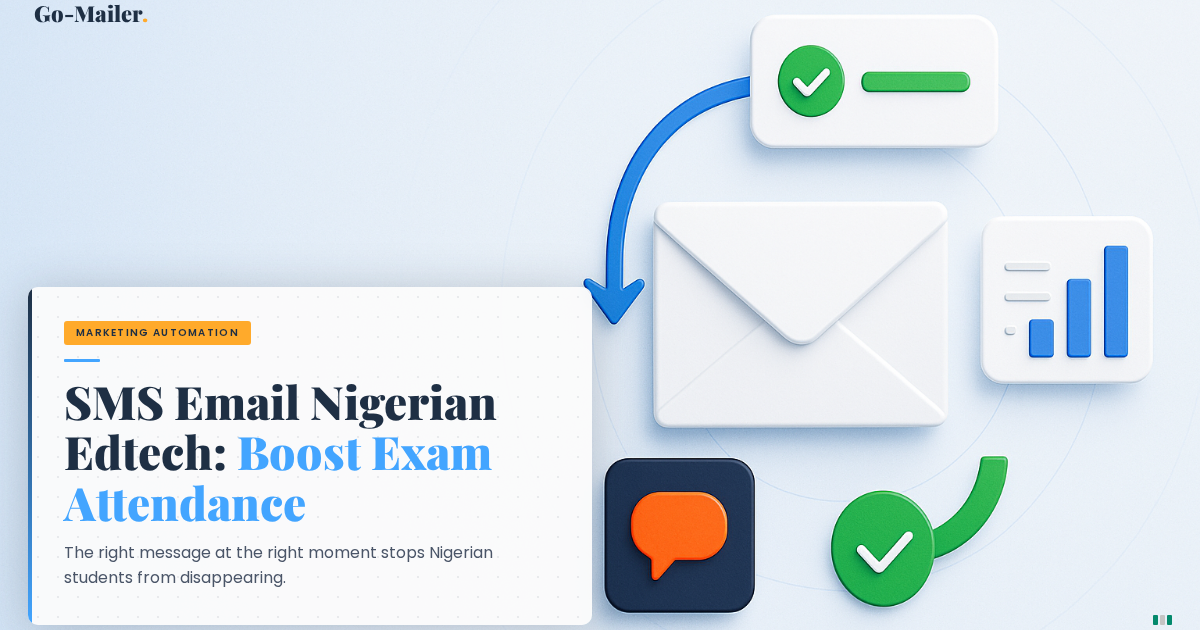
How SMS and Email Help Nigerian EdTech Platforms Boost Class Attendance and Exam Readiness
Across Nigerian EdTech platforms, low attendance and last-minute exam panic are costing learners results — and costing platforms their reputation. The fix is not a fancier app or a bigger content library. It is well-timed, personalised communication delivered through SMS and email.
When Nigerian EdTech operators build SMS email campaigns around the learner journey, attendance climbs and exam performance follows. Here is how to do it deliberately.
Why Nigerian EdTech Learners Drop Off Before Exam Day
The dropout problem in Nigerian EdTech is not a content problem. Most platforms already have decent lesson libraries. The real issue is that life gets in the way, and the platform says nothing.
Erratic data access and competing offline priorities mean learners forget scheduled classes without external nudges. A learner who intended to join a Tuesday evening session is now handling a family obligation or stuck in Lagos traffic — and your in-app notification fired into a phone that has not connected to the internet since morning.
Nigerian learners often juggle work, family, and study simultaneously. That makes passive course platforms — the kind that sit quietly and wait to be opened — easy to abandon. The learner does not quit; they just stop showing up, and the platform never follows up.
This is precisely why platforms that rely solely on in-app notifications miss a large portion of their audience. If a learner has not opened the app in five days, no in-app alert reaches them. SMS and email do.
What makes this more urgent is the timing. Dropout spikes consistently appear two to three weeks before major exams — JAMB, WAEC, or professional certification tests. Ironically, this is exactly when consistent engagement matters most. Learners pull back right when they should be leaning in, often because anxiety and overwhelm go unaddressed. A platform that communicates through that window keeps learners in the game.
Building an SMS Reminder Sequence That Actually Moves Learners to Action
Use Two Touchpoints, Not One
A single reminder SMS is easy to miss or dismiss. Sending a class reminder 24 hours before a live session and a second one 30 minutes before creates two distinct opportunities for the learner to act. The 24-hour message gives them time to plan; the 30-minute message removes the excuse of forgetting.
This two-touchpoint structure consistently outperforms a single blast, especially for Nigerian EdTech exam audiences where schedules shift daily.
Make It Personal, Not Generic
"Class starting soon" is not a message — it is noise. Nigerian learners have developed a fast filter for generic copy, and it usually ends with an ignored or deleted message.
Personalise SMS content with the learner's first name and the specific class topic. "Chidi, your WAEC Chemistry — Organic Compounds class starts in 30 minutes" is a different message entirely. It signals that the platform knows who the learner is and what they signed up for.
Deliver Reliably Across All Networks
Use shortcodes or local Nigerian long codes to ensure high deliverability across MTN, Airtel, Glo, and 9mobile networks. Messages sent through unverified routes get flagged or silently dropped, and you will never know a learner missed a reminder because of a delivery failure.
Platforms on Go-Mailer benefit from infrastructure built specifically for the Nigerian market — no worrying about international routing issues that quietly kill your delivery rates.
Re-Engage With Purpose After Absences
Trigger a re-engagement SMS after two consecutive absences. The framing matters here. Do not lead with what the learner missed — lead with where they are going. "Fatima, your ICAN exam is in six weeks. Your study group meets again on Thursday — come back strong" is more likely to get a response than "You missed two sessions."
Designing Email Campaigns That Build Exam Readiness Week by Week
Build a Countdown Series Around the Exam Calendar
A six-to-eight week countdown email series is one of the most effective structures for Nigerian EdTech exam preparation. Each email maps to a specific week in the learner's revision journey — practice topics in weeks one and two, mock tests in the middle weeks, and focused revision in the final stretch.
This approach positions the platform as a guide through the exam process, not just a content host. It also gives learners a structure when anxiety would otherwise make it hard to know where to start.
Use Progress Summaries to Create Accountability
Progress summary emails — showing each learner how many lessons they have completed versus how many remain — create a quiet accountability loop. Seeing "You have completed 14 of 22 modules. Your exam is in four weeks" is motivating in a way that no motivational quote ever is.
These emails also give learners a reason to log back in, which improves platform engagement metrics alongside exam outcomes.
Serve High-Value Content in the Final Two Weeks
In the final two weeks before a major exam, shift your email content toward curated past-question digests and examiner tip emails. This is where the SMS email Nigerian EdTech equation really pays off — the platform becomes a study partner, not just a subscription.
Learners who receive structured, exam-specific content from their platform in the final days before JAMB or WAEC are far more likely to attribute their preparation — and their results — to that platform.
Segment by Exam Type
JAMB candidates, WAEC students, and professional certification learners need different content, different tones, and different sending cadences. A secondary school student preparing for WAEC English has different anxieties than an accountant sitting for ICAN finals.
Segmenting your email list by exam type is not optional if you want your campaigns to land. Generic broadcast emails to your full list are the email equivalent of that "class starting soon" SMS — technically sent, practically ignored.
Combining SMS and Email Into One Coordinated Engagement Strategy
Give Each Channel a Distinct Role
SMS and email are not interchangeable. Use SMS for time-sensitive nudges — class reminders, exam countdowns, urgent deadlines. Use email for richer content: study guides, mock test results, progress reports, and motivational stories from past learners who passed the same exam.
When each channel does its specific job, the learner experience feels coherent rather than cluttered.
Avoid Channel Fatigue
Sending SMS and email on the same day for the same message creates noise and accelerates opt-outs. Space the channels at least 12 hours apart. If you send an email on Monday morning about an upcoming mock test, let the SMS follow on Monday evening or Tuesday morning.
Use Automation to Connect the Two Channels
Set up automation triggers so that a learner who opens an exam-prep email but does not attempt the linked mock test receives a follow-up SMS within 48 hours. This kind of cross-channel logic — available through platforms like Go-Mailer — turns your SMS email Nigerian EdTech workflow from a broadcast machine into a responsive engagement system.
Track Performance Separately
Open rates and click-through rates belong to email. Delivery rates and response rates belong to SMS. Tracking them in the same bucket obscures what is actually working. Once you know which channel converts better for each learner segment, allocate your message types accordingly.
The EdTech Platforms That Win in Nigeria Communicate With Intention
SMS and email are not interchangeable channels — each has a distinct role in moving Nigerian learners from enrolled to exam-ready. The strongest EdTech platforms deploy both with clear intent, not just because they have the tools, but because they understand the learner's journey well enough to know what to say and when to say it.
Personalisation and timing matter more than message volume. A well-timed SMS reminder or a segmented email sequence built around the Nigerian exam calendar will outperform a broadcast blast every single time.
When you build your SMS email workflows around JAMB dates, WAEC timetables, and professional certification windows, you stop being a platform learners log into occasionally. You become the voice that shows up in their corner, consistently, through every stage of their exam journey. That is the kind of communication that earns results — and the kind that builds a platform's reputation in the Nigerian EdTech market.


Be the first to comment