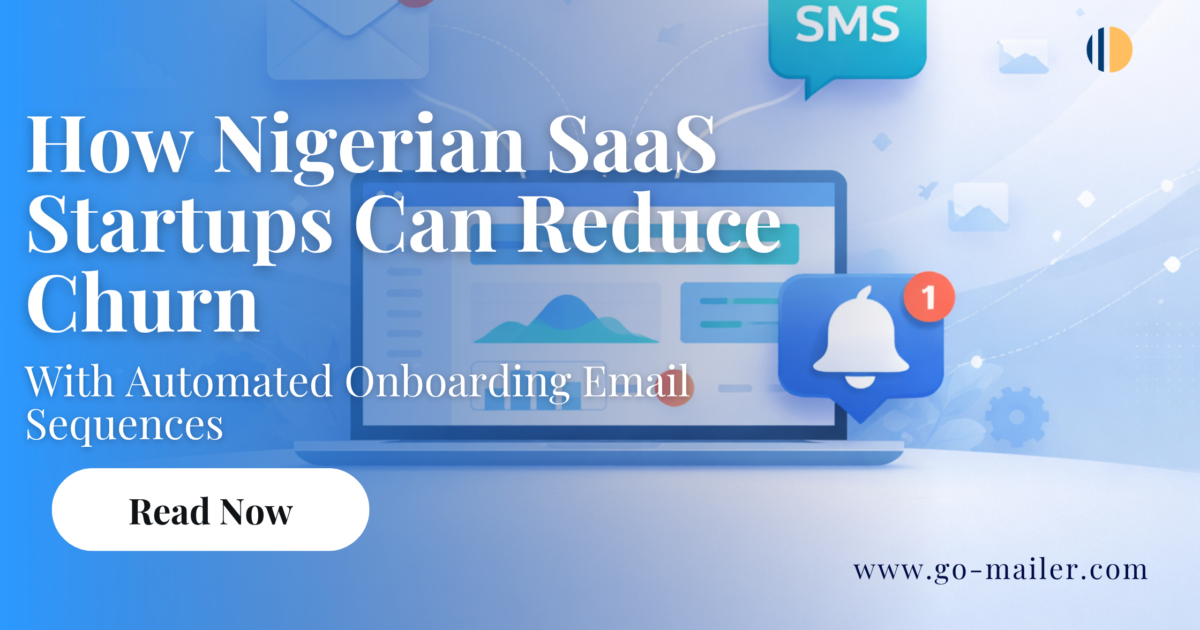
Most Nigerian SaaS startups lose their highest-risk users in the first 14 days not because the product is broken, but because new users never experience its value.
Automated onboarding email sequences give founders a scalable way to guide users from sign-up to activation without hiring a dedicated success team. If you are building a SaaS product in Nigeria and churn is eating your growth, your onboarding flow is the first place to fix.
Why Churn Starts at Onboarding, Not at Renewal
Most SaaS founders track churn at renewal. That is already too late.
The users who quietly disappear after signing up, never completing setup, never converting to paid, rarely trigger an alert. They just stop showing up. By the time a renewal fails or a free trial expires without conversion, the decision to leave was made weeks earlier.
This is the silent churn problem that is particularly expensive for Nigerian SaaS products. Users who never complete onboarding go untracked until a billing event reveals they were never really there.
The Activation Gap Is Where Churn Actually Begins
There is a specific moment every SaaS product has, the point where a user first gets real, tangible value. Before that moment, a user is just a sign-up. After it, they have a reason to stay.
The distance between registration and that first value moment is the activation gap. Closing it quickly is the single biggest lever you have on retention. Globally, users who reach activation within seven days are three times more likely to retain long-term. There is no reason to believe that logic works differently for Nigerian SaaS products.
What makes the Nigerian context harder is digital trust. Users in Nigeria are more cautious about new platforms, more likely to abandon if the path forward is unclear, and less likely to give a product a second chance once confusion sets in. A welcome screen and a generic confirmation email will not cut it. Users need active guidance, and they need it early.
What an Effective Automated Onboarding Email Sequence Actually Looks Like
The goal of an onboarding sequence is not to showcase your product. It is to get one user to one meaningful action, as fast as possible. Here is how to structure it.
Day 0 — The Welcome Email
Send this immediately after sign-up. Confirm the account was created, tell the user exactly what to expect next, and surface a single next step.
Not listing five features or a product tour with twelve tabs. The temptation to introduce everything at once is the most common mistake in onboarding emails, and it is the one that creates the most drop-off.
Day 1–2 — The Activation Nudge
By now, you should know whether the user has completed that first step. If they have not, this email exists to bring them back.
Identify the one action that defines activation for your specific product. For a project management tool, it might be creating a first project. For a payroll SaaS, it might be adding an employee. For an invoicing platform, it might be sending a first invoice. Name that action directly in the email and link straight to it not to the dashboard homepage.
Day 3–5 — Value Demonstration
This email is not about what your product does. It is about what someone like your user has already achieved with it.
Show a specific use case. Share a short customer result. Walk through a scenario that mirrors the problem your user signed up to solve. This is where social proof, when it is local and specific, earns real trust. A fintech founder in Lagos reading about how another Lagos-based business processed their first month of payroll on your platform is far more persuasive than a generic testimonial.
Day 7–10 — Check-in or Segmentation Trigger
By day seven, your sequence should split based on behaviour.
Users who have activated get a different message, one that introduces a second feature, encourages a team invite, or deepens their engagement. Users who have not activated need a re-engagement email that acknowledges the gap without being aggressive about it. Something as simple as asking whether they ran into a problem or offering a short setup call can recover users who would otherwise be gone.
This branching logic is where automated onboarding email sequences in Nigeria go from a nice-to-have to a genuine retention tool.
Building the Sequence for the Nigerian SaaS Context
Generic SaaS onboarding templates are built for users with reliable broadband, desktop browsers, and low friction between reading an email and acting on it. That is not always the Nigerian user’s reality, and your sequence needs to account for it.
Write for mobile and low-bandwidth conditions. these should contain short paragraphs, plain text formatting where possible, and minimal image dependency. If your email only renders well on a laptop with a fast connection, a significant portion of your Nigerian audience will never see it properly.
Keep email content self-contained. Do not build an onboarding email that only makes sense after the user clicks through to watch a video or load a complex in-app walkthrough. Assume that some users will read the email during a commute, on mobile data, and close it before clicking anything. The email itself should deliver value.
Use SMS as a parallel channel. Nigerian users have high SMS open rates, and many actively ration mobile data during certain periods. A well-timed SMS nudge, sent the morning after a missed activation step, can recover users who missed the email entirely. Platforms that support both email and SMS in one workflow make this significantly easier to execute without doubling your operational overhead.
Localise your copy. Reference naira pricing. Acknowledge local payment flows. Use business contexts that feel familiar to a Nigerian founder or operations manager. The trust gap that generic SaaS templates leave open is one that localised copy can close.
Measuring Whether Your Onboarding Sequence Is Actually Reducing Churn
Building the sequence is step one. Knowing whether it is working is step two, and most teams skip it.
Activation rate is your primary metric. Track the percentage of new sign-ups who complete your defined activation action within seven days, before and after deploying the sequence. That number tells you more about retention potential than any other single data point.
Monitor email engagement by position in the sequence. If your day three email has a dramatically lower open rate than day one, something is breaking the momentum. A drop-off in clicks at a specific email tells you where confusion or disinterest is killing the sequence.
Correlate sequence completion with 30-day and 90-day retention. Open rates are not a retention metric. What you want to confirm is that users who complete the onboarding sequence actually stay longer and convert at higher rates. If that correlation is not there, the sequence needs rethinking, not just rewriting.
Test send timing against Nigerian usage patterns. Lunch hours and the window after 8 PM tend to be high-engagement periods for Nigerian users. A/B test your subject lines and send times before assuming your defaults are optimal.
Go-Mailer’s automation tools let you set up this kind of behaviour-triggered branching without writing a single line of code and since billing is in naira, there are no USD conversion costs eating into your budget as you scale the volume.
Onboarding Is a Revenue Decision, Not a UX Afterthought
Churn in Nigerian SaaS products is most often an onboarding failure. Users who do not reach activation quickly will not stay, regardless of how good the product actually is.
A well-structured automated onboarding email sequence, built for Nigerian connectivity habits, SMS-first behaviour, and local business context, can close the activation gap at scale without adding headcount to do it.
The metrics that matter are activation rate, sequence completion, and their correlation with actual retention. Open rates feel good. Retention pays the bills.

Be the first to comment